 Night Logic
Home › Guides › How long should you expose in astrophotography?
How long should you expose in astrophotography?
Updated 20 October 2026 · By William Dutton, developer of Night Logic: Astrophotography
Most deep-sky imagers on a tracking mount use 60–300 second sub-exposures and collect 2–8 hours of total integration. This guide explains what sets those numbers for your telescope, mount, camera, and sky.
The short answer. For deep-sky imaging on a tracking mount, start with 60–300 second sub-exposures and aim for 2–8 hours of total integration. Go shorter under bright skies, with fast optics, or with an unguided mount; go longer under dark skies, with slower optics, and with accurate guiding.
Two different questions
“How long should I expose?” actually hides two separate decisions, and mixing them up is the most common beginner mistake.
- Sub-exposure length is how long each individual frame runs: 30 seconds, 120 seconds, 300 seconds.
- Total integration time is the sum of every good frame you stack: 1 hour, 4 hours, 10 hours.
Sub length is mostly limited by your equipment and sky. Total integration is limited by your patience, the weather, and how long the target stays up. Image quality depends far more on the second number.
Choosing a sub-exposure length
Four things cap how long each frame can be.
1. Tracking accuracy
If your mount drifts, stars turn into streaks. An unguided equatorial mount is limited by periodic error and polar alignment, typically a minute or two at moderate focal lengths. A guided mount can hold tight stars for five minutes or more. Longer focal lengths magnify every tracking error, so a 1000 mm telescope is far less forgiving than a 135 mm lens.
2. Sky brightness
Each frame carries a fixed amount of camera read noise. A sub only needs to be long enough for the light-polluted sky background to swamp that read noise; after that, going longer yields diminishing returns. That is why under a bright suburban sky (Bortle 7–9) 30–90 second subs are usually plenty, while under a truly dark sky you can keep going longer. See the Bortle scale guide.
3. Optical speed (f-ratio)
A fast f/2 system gathers light far quicker than an f/7 one. Fast optics reach the sky-limited point sooner, so they need shorter subs. Slow optics need longer ones to get the same benefit.
4. Field rotation and the cost of a lost frame
On an alt-azimuth mount the field slowly rotates, which blurs the edges of long frames, so subs are kept short (often 10–30 seconds) and rotation is corrected in stacking. Separately, shorter subs make each bad frame cheaper: a satellite or a wobble that ruins a 10-minute sub costs ten minutes of data; at 2 minutes it costs two.
Starting points by setup
These are starting points, not rules. Take a test frame, check star shapes at 100% zoom and the histogram, then adjust.
| Setup | Typical sub length | Main limit |
|---|---|---|
| Camera on a fixed tripod | A few seconds to ~20 s (500 rule or NPF rule) | Earth’s rotation |
| Star tracker with a wide lens | 30–120 s | Polar alignment, tracking error |
| Equatorial mount, unguided | 30–120 s | Periodic error, focal length |
| Equatorial mount, guided, dark sky | 120–300 s | Wind, satellites, saturation |
| Equatorial mount, guided, bright suburban/city sky | 30–120 s | Sky glow reaches the sky-limited point early |
| Alt-azimuth mount | 10–30 s | Field rotation |
| Narrowband filters (Ha, OIII, SII) | 300–600 s | Filter blocks most sky glow, so subs can run longer |
The NPF rule, for untracked shots
The NPF rule gives the longest untracked exposure before stars trail:
(35 × aperture f-number + 30 × pixel pitch in µm) ÷ focal length in mm.
It works better than the older 500 rule on high-resolution sensors.
How much total time you need
Signal-to-noise ratio grows with the square root of total exposure time. Four times the data gives you roughly twice the signal-to-noise, which is why the first hour looks like a big jump and the tenth hour looks like a small one.
| Total integration | What to expect |
|---|---|
| ~1–2 hours | A starter stack. Bright targets (Orion Nebula, Andromeda Galaxy, bright clusters) show clear detail; faint nebulosity is noisy. |
| ~3–5 hours | A solid image. Most galaxies and emission nebulae look clean and take processing well. |
| 8+ hours | High-end. Faint dust, tidal tails, and faint outer regions come out. Needed for very dim targets or bright skies. |
Surface brightness decides which row applies. A bright nebula can look great in two hours; a faint reflection nebula or galaxy halo can still look thin at ten. Brighter skies push everything one row down. The same target needs far more time from a city than from a dark site.
Planets
Planets are the exception to everything above. They are bright and small, and the atmosphere blurs them from moment to moment, so the technique is lucky imaging: record a video made of thousands of very short frames (typically a few milliseconds to a few tens of milliseconds each), then stack only the sharpest ones.
Video length is limited by planetary rotation. Jupiter spins once in under ten hours, so a video much longer than a couple of minutes will smear surface detail unless you correct for the rotation in software. Mars and Saturn allow somewhat longer runs.
What moonlight changes
A bright Moon is effectively a light-polluted sky. Around full Moon it raises the background the same way moving to a worse Bortle class would: you reach the sky-limited point sooner (shorter subs are fine), and each hour of data is worth less. Many imagers use the bright-Moon nights for narrowband imaging, planets, or the Moon itself, and save the dark half of the month for broadband galaxy and nebula work.
Letting software do the arithmetic
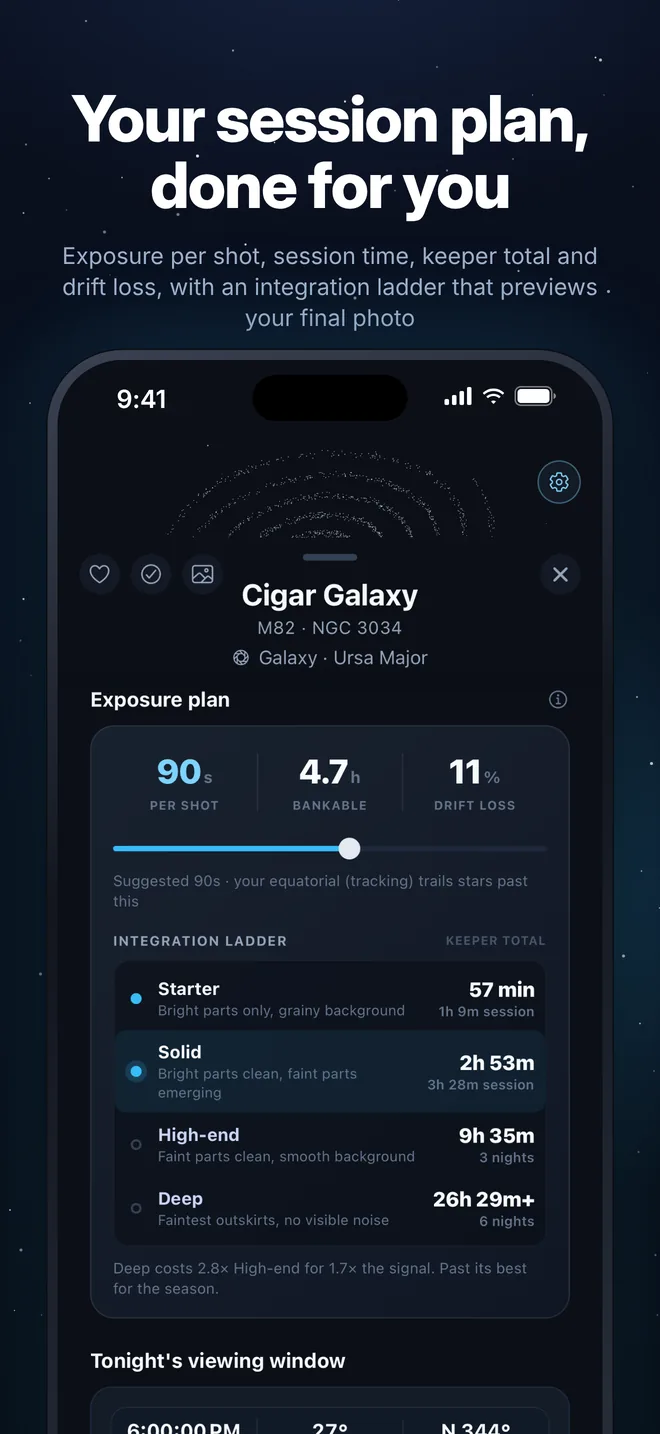
Putting these together for your own gear is the hard part. Sub length depends on your mount, f-ratio, camera, and sky; how much time you need depends on the target; and whether you can collect it depends on how long the target is up tonight. Night Logic does that calculation for the rig you own: its Pro exposure plan suggests a sub length (and tells you what is capping it), estimates the share of frames you will lose to drift, and shows an integration ladder so you can see what two, four, or eight hours of data buys on that target under your sky.
Frequently asked questions
Is a longer sub-exposure always better?
No. Longer subs collect more light per frame, but they also risk trailed stars, saturated bright stars, and losing the whole frame to a satellite, a gust of wind, or a passing cloud. Past the point where sky background noise dominates read noise, longer subs add little. Total integration time matters more than any single sub.
How many sub-exposures do I need?
Divide your target total integration by your sub length. Four hours of data at 120-second subs is 120 frames; at 300-second subs it is 48. Plan for roughly 5–15% extra to cover frames you will throw away for trailing, clouds, or satellites.
Does one 60-minute exposure beat sixty 1-minute exposures?
Almost never in practice. Stacking many shorter frames gives nearly the same signal-to-noise as one long frame once the sky background dominates the noise, and it is far more forgiving: one bad frame costs a minute, not an hour. It also avoids saturating bright stars and lets rejection algorithms remove satellite trails.
What is the 500 rule?
A rule of thumb for untracked camera-on-tripod shots: divide 500 by your lens focal length (multiplied by the crop factor on smaller sensors) to get the longest exposure in seconds before stars visibly trail. The NPF rule is more accurate on modern high-resolution sensors because it also accounts for aperture and pixel size.
How long should I expose for planets?
Planets are imaged as video, not long exposures. Individual frames are typically a few milliseconds up to a few tens of milliseconds, and each video runs for roughly one to three minutes before planetary rotation starts to smear detail. Thousands of the sharpest frames are then stacked.
Night Logic: Astrophotography is a free iPhone app that ranks tonight’s targets for your telescope, mount, and camera, and builds an exposure plan for each one. Android is coming soon to Google Play.