 Night Logic
Home › Guides › What deep-sky target should you photograph tonight?
What deep-sky target should you photograph tonight?
Updated 20 October 2026 · By William Dutton, developer of Night Logic: Astrophotography
A good target is high in the sky for hours, far from the Moon, bright enough for your sky, and sized right for your field of view. Here is how to check each one, with classic targets by season.
The short answer. A good target for tonight is one that is high in the sky for hours, far from the Moon, bright enough for your sky, and the right size for your field of view. If a target fails any one of those, the others rarely make up for it.
What makes a good target tonight
1. Altitude and time above the horizon
The lower a target is, the more atmosphere you shoot through. Haze, blur, and light-pollution gradients all get worse near the horizon. Check two numbers: the target’s peak altitude, and how many hours it stays high enough (many imagers use 30–40° as a floor). A target that peaks at 70° and stays high for five hours beats one that scrapes 35° for ninety minutes.
2. The Moon
Moon phase and distance from your target matter. A thin crescent barely registers; a gibbous Moon within 40–60° of your target raises the background significantly. Plan faint broadband targets for the dark half of the lunar month, and use bright-Moon nights for narrowband or planets.
3. Surface brightness versus your sky
An object’s catalogue magnitude can be misleading, because it is the total light spread over its whole area. What matters for imaging is surface brightness. Large, faint objects are far harder than small, compact ones of the same magnitude. The brighter your sky (see the Bortle scale), the more you should favor high surface-brightness targets.
4. Size versus your field of view
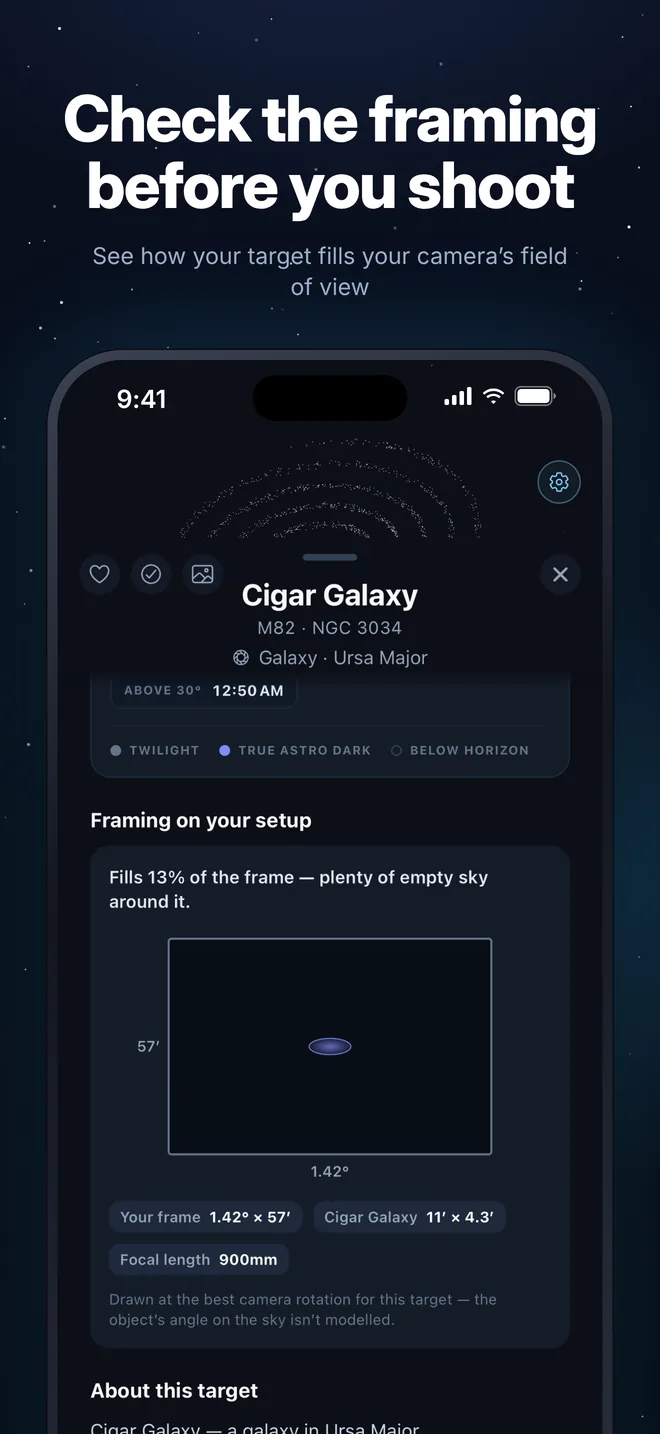
Your focal length and sensor size determine your field of view. A target much bigger than the frame needs a mosaic; one much smaller becomes a tiny blob. For most targets, ideal framing has the object filling roughly a quarter to two-thirds of the frame. It is worth checking on a framing preview before you set up.
5. Your mount and optics
A fast, wide system loves big nebulae; a long focal length suits small planetary nebulae and galaxies. Alt-az mounts have extra trouble near the zenith because of field rotation. A good target for your friend’s rig is not always a good target for yours.
Classic targets by season (northern hemisphere)
| Season | Good targets |
|---|---|
| Spring | Leo Triplet (M65, M66, NGC 3628), M81 & M82, Whirlpool Galaxy (M51), Pinwheel Galaxy (M101), Virgo Cluster galaxies |
| Summer | Lagoon (M8) and Trifid (M20) nebulae, Eagle Nebula (M16), Omega Nebula (M17), Dumbbell Nebula (M27), Hercules Cluster (M13), North America Nebula |
| Autumn | Andromeda Galaxy (M31), Triangulum Galaxy (M33), Veil Nebula, Double Cluster, Heart and Soul Nebulae (late autumn) |
| Winter | Orion Nebula (M42), Horsehead and Flame Nebulae, Rosette Nebula, Pleiades (M45), Crab Nebula (M1), Auriga clusters (M36, M37, M38) |
In the southern hemisphere, seasons flip and the Carina Nebula, the Magellanic Clouds, Omega Centauri, and the Southern Cross region are standouts.
A simple planning routine
- Check the forecast: clouds, transparency, and seeing for the hours after dark.
- Check the Moon: phase, rise/set, and its distance from your candidate targets.
- List what is up and high for the longest time during the darkest hours.
- Check framing on your sensor and focal length.
- Work out how much total time you need and whether tonight can deliver it. See how long to expose.
That is the routine Night Logic automates. It grades everything above your horizon against your rig, Bortle class, and the Moon, shows the factors behind each grade, and puts the best option first.
Frequently asked questions
What should a beginner photograph first?
Start with bright, large, forgiving targets that match your focal length: the Orion Nebula (M42), the Andromeda Galaxy (M31), the Pleiades (M45), the Lagoon Nebula (M8), and the Dumbbell Nebula (M27) are classic first targets, depending on the season.
Does the Moon ruin deep-sky astrophotography?
It hurts broadband imaging of faint targets but not everything. Around full Moon, switch to planets, the Moon itself, bright clusters, or narrowband imaging of emission nebulae. Keep your target away from the Moon in the sky.
How high should a target be in the sky?
Higher is better. Below about 30° altitude you look through much more atmosphere, which dims, blurs, and adds gradients. Aim for targets spending as much time as possible above 40–50°.
Night Logic: Astrophotography is a free iPhone app that ranks tonight’s targets for your telescope, mount, and camera, and builds an exposure plan for each one. Android is coming soon to Google Play.